Table of Contents
ToggleWhen a kitchen or bathroom remodel budget gets tight, builders surplus stores can be a lifesaver. These outlets offer brand-name cabinets at steep discounts, sometimes 30% to 70% below retail, but shopping there requires a different approach than ordering custom or stock cabinets from a big-box store. Understanding what builders surplus is, how inventory works, and what to watch for during selection can mean the difference between scoring a deal and ending up with mismatched boxes that don’t fit the space. This guide walks through everything needed to make smart decisions when buying surplus cabinets.
Key Takeaways
- Builders surplus kitchen and bath cabinets offer 30% to 70% discounts compared to retail prices, making high-end brands and quality construction accessible on tight renovation budgets.
- Successful surplus shopping requires flexibility in design plans and accurate space measurements, since inventory constantly changes and specific styles or sizes may not be available on future visits.
- Quality assessment is critical when buying surplus cabinets—prioritize plywood construction, dovetail drawer joints, and soft-close hinges over cosmetic condition, which can often be overlooked if the flaw won’t show after installation.
- Base cabinets must anchor securely into wall studs using a level reference line, not floor measurements, since floors are rarely perfectly level and proper installation ensures safety and longevity.
- Mixing surplus cabinet purchases with new custom elements like countertops, crown molding, or hardware creates a cohesive, designer-quality look while maintaining significant overall savings.
What Is Builders Surplus and Why Should You Shop There?
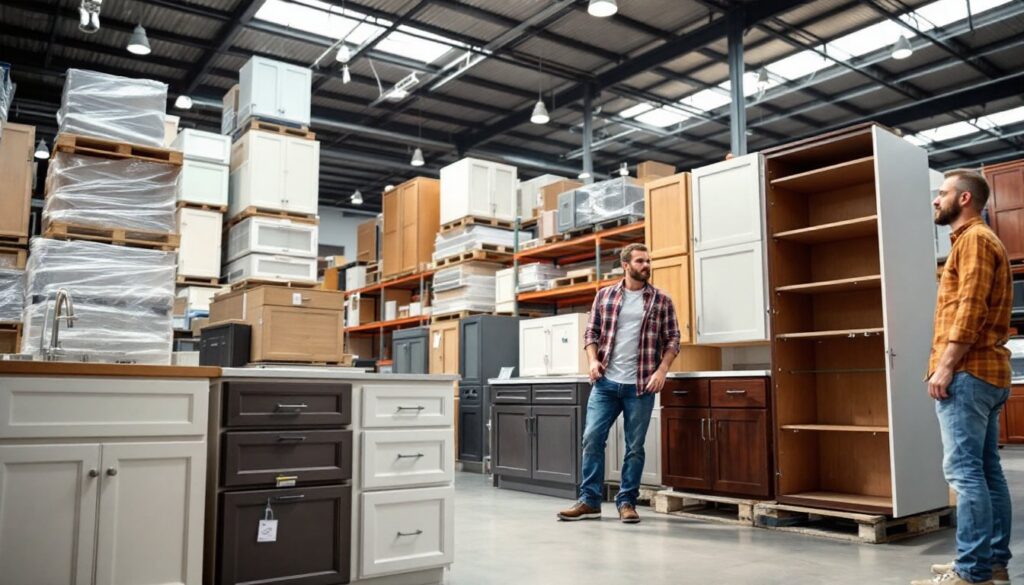
Builders surplus stores specialize in excess inventory, overstock, discontinued lines, and customer returns from manufacturers and contractors. Unlike traditional retailers that order exactly what’s needed, surplus outlets buy pallets of cabinets that didn’t sell through standard channels. This creates opportunities for steep savings but also introduces variability in what’s available on any given day.
The main advantage is price. A shaker-style base cabinet that retails for $400 might sell for $150 to $200 at a surplus store. Bathroom vanities see similar markdowns. The catch: inventory constantly changes, and there’s no guarantee a specific style or size will be in stock next week. Shoppers need flexibility in design plans and the willingness to adapt measurements to what’s available.
Another benefit is access to higher-end brands. Surplus stores often carry cabinets from mid-tier and premium manufacturers that would normally sit outside a DIY budget. This means better construction, plywood box construction instead of particleboard, dovetail drawer joints instead of stapled corners, and soft-close hinges as standard equipment. For anyone willing to hunt, the quality-to-price ratio can beat anything at a chain store.
Understanding the Builders Surplus Business Model
Surplus outlets operate on thin margins and high turnover. They purchase liquidation lots, canceled orders, and factory seconds in bulk, then resell quickly to free up warehouse space. This model keeps prices low but means limited customer service compared to traditional retailers. Don’t expect design consultations, free delivery, or extended warranties.
Most surplus stores sell cabinets as-is with minimal returns accepted. Inspect every cabinet thoroughly before purchase. Check for dents, scratches, missing hardware, and damaged finishes. Some stores mark down cabinets with cosmetic flaws even further, a $300 cabinet with a small ding on the toekick might drop to $100. If the flaw won’t show after installation or can be repaired, that’s money saved.
Timing matters. Inventory refreshes vary, but many stores receive shipments weekly or biweekly. Building relationships with staff can provide advance notice when specific cabinet types arrive. Some shoppers visit regularly, essentially treating the surplus store like a treasure hunt until they’ve assembled a full kitchen’s worth of matching cabinets.
Types of Kitchen & Bath Cabinets Available at Builders Surplus
Surplus inventory typically includes several cabinet categories, though availability fluctuates. Base cabinets (standard height 34.5 inches to accommodate countertops) are common, especially in standard widths: 12″, 15″, 18″, 24″, 30″, and 36″. Odd sizes like 9″ or 42″ appear less frequently but can solve tricky layout problems when they do.
Wall cabinets usually come in 12″, 15″, 18″, 24″, 30″, and 36″ widths with heights of 30″, 36″, or 42″. Taller cabinets that reach near-ceiling height show up occasionally, often from discontinued lines. These are worth grabbing if the style works, they maximize storage and create a custom look without custom pricing.
Specialty cabinets like lazy Susans, blind corner units, pull-out pantries, and drawer base cabinets appear less consistently. When they do, they’re often deeply discounted because fewer shoppers need those exact configurations. A 36″ corner base cabinet with a lazy Susan mechanism retailing for $600+ might sell for $200.
Bathroom vanities range from basic 24″ single-sink units to 60″ double-sink configurations. Surplus stores often carry vanities without tops, allowing buyers to choose their own countertop material and sink style. This actually increases design flexibility while keeping costs down. Designers looking for unique kitchen solutions often recommend mixing surplus cabinets with custom elements like countertops or backsplashes to balance budget and style.
Finish options vary by lot. Common finishes include white or off-white painted, natural oak, maple, and cherry stains. Gray-painted cabinets and espresso finishes appear frequently, reflecting recent trends. Matching an entire kitchen requires either buying all cabinets from the same lot or selecting a neutral finish that accommodates slight variation.
How to Choose the Right Cabinets for Your Kitchen or Bathroom
Start with accurate measurements of the space. Measure wall lengths, ceiling height, and the locations of windows, doors, electrical outlets, and plumbing. Note any obstructions like radiators or ductwork. When shopping surplus, flexibility matters, being open to adjusting a layout by a few inches creates more opportunities to use available inventory.
Draw a rough floor plan showing base cabinet placement and a wall elevation showing upper cabinets. Mark appliance locations and their exact dimensions. A standard 30″ range requires a 30″ base cabinet opening, but a 36″ refrigerator might need a 36″ opening or could sit flush against a wall. Having these measurements on hand prevents buying cabinets that won’t fit.
Prioritize function over perfect aesthetics. If the goal is a U-shaped kitchen but the surplus store has enough cabinets for an L-shaped layout with a freestanding island, consider adapting the plan. An island built from surplus base cabinets topped with butcher block can cost less than continuing built-in cabinetry and often improves workflow.
Consider mixing cabinet heights for visual interest. Standard 30″ wall cabinets above a refrigerator or range look fine, but using 42″ cabinets on the main wall run creates a more custom appearance and adds storage. As long as the finish and door style match, varying heights looks intentional.
For bathrooms, start with the vanity size that fits the plumbing rough-in. Standard sink drains sit 15″ to 20″ from the back wall and centered side-to-side in the cabinet. Changing plumbing locations adds cost, so find a vanity that works with existing drain and supply line positions. A 36″ vanity works in most single-sink bathrooms, while 48″ or 60″ double-sink units need adequate wall space and sufficient clearance for doors to swing.
Quality Considerations When Buying Surplus Cabinets
Inspect box construction first. Quality cabinets use ½” plywood sides and ¾” plywood back panels, not thin hardboard backs stapled in place. Plywood resists moisture better and holds screws more securely during installation. Budget cabinets substitute particleboard or MDF, which works fine in dry locations but can swell if a sink leaks or humidity spikes.
Check drawer construction and operation. Look for dovetail or dowel joints at corners rather than staples or glue alone. Drawers should ride on full-extension ball-bearing slides, not cheap plastic tracks. Open and close each drawer, smooth, quiet operation with soft-close mechanisms indicates quality hardware that’ll last.
Examine door hinges and alignment. European-style adjustable concealed hinges are standard on modern cabinets and allow fine-tuning after installation. Six-way adjustability (up, down, left, right, in, out) makes it easier to get uniform reveals between doors. Exposed hinges or non-adjustable types make installation harder and results less polished.
Salvaged and reclaimed materials have become popular in upscale kitchen design, but surplus cabinets differ from true salvage. Surplus means new or near-new overstock: salvage means genuinely reclaimed. Both offer savings, but expect different condition levels and installation challenges.
Inspect finish quality closely. Minor flaws like small paint drips or slight color variation between doors are common in surplus inventory and don’t affect function. Deep scratches, chipped edges, or delaminating veneer are harder to fix and should trigger negotiation for additional discounts. Missing hardware like knobs or pulls isn’t a dealbreaker, replacements cost a few dollars per piece and allow personalization anyway.
Cost Savings: How Much Can You Actually Save?
Price comparisons depend on cabinet quality tier and regional markets, but typical savings at builders surplus stores range from 30% to 70% off retail. A basic stock kitchen (10′ x 10′ layout, approximately 12 linear feet of cabinetry) retails for $3,000 to $5,000 at home centers. The same quantity of comparable cabinets from a surplus outlet might cost $1,200 to $2,500.
Mid-range cabinets see proportionally larger savings. A kitchen that would cost $8,000 to $12,000 retail could drop to $3,000 to $5,000 at surplus pricing. Premium cabinets with features like soft-close drawers, plywood construction, and furniture-grade finishes might retail for $15,000+ but sell surplus for $5,000 to $7,000.
Bathroom vanities follow similar patterns. A quality 36″ vanity retailing for $500 to $800 might sell for $200 to $350 at surplus. Double-sink 60″ vanities that command $1,200 to $2,000 retail can drop to $500 to $800.
These savings assume finding enough matching cabinets to complete the project. Piecemeal purchasing over multiple visits might extend the timeline but allows cherry-picking the best deals. Some shoppers buy surplus base and wall cabinets, then add new trim pieces, crown molding, and hardware to create a cohesive look.
Factor in countertops, installation, and finishing costs separately. Surplus cabinets save money on the boxes themselves, but granite, quartz, or solid-surface countertops still cost $40 to $100+ per square foot installed. Laminate runs $20 to $50 per square foot. Professional installation adds $50 to $150 per linear foot depending on complexity and region. DIY installation erases that cost but requires skill and time.
Installation Tips for Builders Surplus Cabinets
Start by checking cabinet dimensions against the space before leaving the store. Measure actual cabinet boxes, not just marked sizes, since manufacturing tolerances occasionally vary. Confirm all cabinets are present if buying a matched set, and verify hinge locations match if installing both left- and right-opening doors side-by-side.
Before installation begins, locate wall studs using a stud finder. Standard 16″ on-center spacing is typical, but older homes may have 24″ spacing or irregular layouts. Mark stud locations clearly, upper cabinets must anchor into studs, not just drywall, to safely hold the cabinet weight plus dishes and glassware. Use 3″ cabinet screws through the mounting rail into studs.
Establish a level reference line for both base and wall cabinets. Floors and ceilings are rarely perfectly level, so measuring up from the floor can create crooked installations. Instead, use a laser level or 4-foot carpenter’s level to strike a horizontal line representing the top of base cabinets (typically 34.5″ above the high point of the floor) and the bottom of wall cabinets (typically 54″ above the floor for 18″ clearance above standard countertops).
Shim base cabinets level and plumb before securing them. Plastic shims work well and won’t compress over time like wood. Check level front-to-back and side-to-side, and use a framing square to verify corners are 90°. Once positioned, screw cabinets together through the face frames before anchoring to walls. Homeowners planning professional-quality results should review detailed cabinet installation techniques before starting.
Wall cabinet installation requires two people or temporary support, a cabinet jack or T-brace works for solo installers. Hang upper cabinets before installing base cabinets to avoid working over finished countertops. Screw through the top and bottom mounting rails into studs, using at least four screws per cabinet.
Various design and layout concepts from sources like Homify can help visualize finished results before starting installation, ensuring the final layout maximizes both function and aesthetics.