Table of Contents
ToggleBuilding a tiny home isn’t as simple as downsizing your square footage and dividing the cost of a conventional house by ten. The per-square-foot price often runs higher than traditional construction, and budgets can swing wildly depending on whether you’re building on a foundation or a trailer, doing the work yourself, or hiring pros. In 2026, prospective tiny homeowners need to understand the full cost picture, from foundation and framing to permits, utilities, and the hidden expenses that catch beginners off guard. This guide breaks down real numbers, identifies cost drivers, and helps DIYers and contractors alike plan a realistic budget for a tiny home build.
Key Takeaways
- The cost of building a tiny home ranges from $30,000–$70,000 for DIY builds and $50,000–$150,000 for professional builds, with per-square-foot costs running higher than traditional construction due to lack of economies of scale.
- Foundation type is the biggest cost variable—permanent foundations run $4,000–$12,000 while trailer-mounted systems cost $4,500–$7,000, making your choice between mobility and affordability a key budget decision.
- Labor accounts for 40–60% of professional builds, so DIY construction can save significant money if you have carpentry skills, though electrical and plumbing work typically require licensed professionals for code compliance.
- Hidden costs like permits ($500–$3,000), site prep ($2,000–$8,000), tool rentals ($1,500–$3,000), and a 10–15% material contingency often catch first-time builders off guard and derail budgets.
- Sourcing reclaimed materials, keeping standard dimensions, choosing simple systems, and handling interior finish work yourself are practical strategies that can reduce the cost of building a tiny home by thousands without sacrificing quality.
- Utility hookup choices dramatically impact budgets—on-grid connections cost $3,000–$10,000 while off-grid systems with solar and battery banks cost $8,000–$25,000 but eliminate monthly utility bills long-term.
What Factors Influence Tiny Home Building Costs?
Tiny home costs vary based on several structural and regulatory factors that affect material quantities, labor requirements, and permitting.
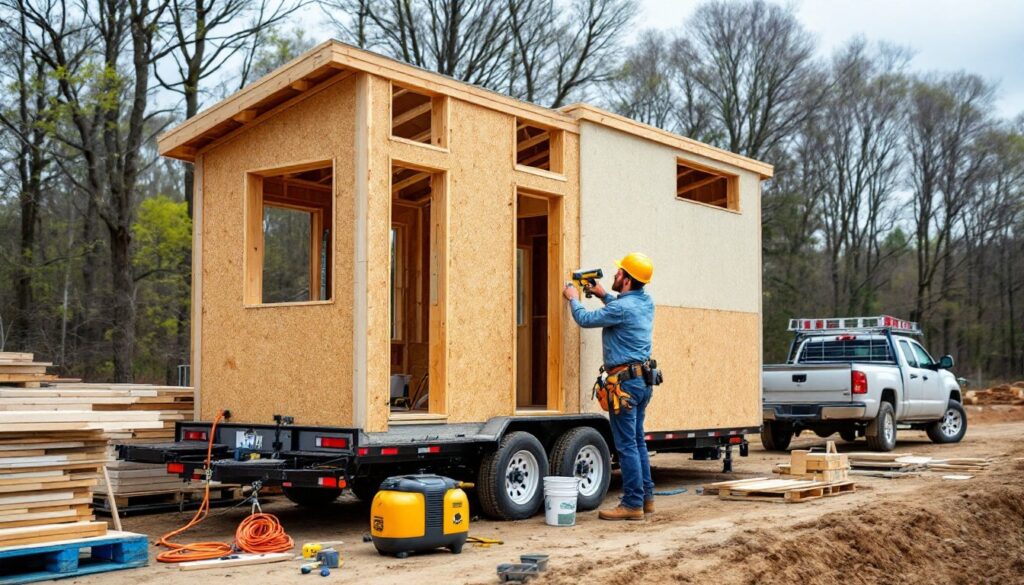
Foundation type is the single biggest cost variable. A permanent foundation, concrete slab, pier-and-beam, or basement, requires excavation, footings, and compliance with local frost line depths. Expect $4,000–$12,000 depending on soil conditions and regional labor rates. A trailer-mounted tiny home (often called a THOW, or tiny house on wheels) eliminates foundation work but requires a heavy-duty trailer rated for the load, typically $4,500–$7,000 for a dual-axle frame.
Square footage and layout complexity drive material and labor costs. A 120-square-foot shell is straightforward: a 400-square-foot home with a loft, dormer windows, and custom cabinetry multiplies framing cuts, fasteners, and finish work. Each additional window, door, or plumbing fixture adds both material cost and labor hours.
Utility hookups and off-grid systems significantly impact budgets. Connecting to municipal water, sewer, and electric runs $3,000–$10,000 if infrastructure is nearby. Off-grid setups, solar panels, composting toilets, rainwater catchment, propane appliances, can cost $8,000–$25,000 upfront but eliminate monthly utility bills.
Permitting and zoning vary widely by jurisdiction. Some counties classify tiny homes on foundations as accessory dwelling units (ADUs), requiring full building permits, septic or sewer hookups, and compliance with the International Residential Code (IRC). Trailer-based homes often fall into an RV or mobile home classification with different, or absent, permitting requirements. Budget $500–$3,000 for permits, inspections, and engineering stamps where required.
Average Cost to Build a Tiny Home in 2026
In 2026, the average cost to build a tiny home ranges from $30,000 to $70,000 for a DIY build and $50,000 to $150,000 for a turnkey professional build. Per-square-foot costs typically run $150–$400, which is higher than conventional construction due to the lack of economies of scale and the proportionally higher cost of fixtures, appliances, and custom joinery in a small space.
Budget-tier builds ($30,000–$45,000) usually involve owner-builders doing most of the work, sourcing reclaimed materials, and keeping finishes simple. Expect basic framing, vinyl or metal siding, laminate countertops, and standard RV or mobile home appliances. These builds often skip luxury items like tankless water heaters or high-end insulation.
Mid-range builds ($50,000–$85,000) include quality materials, LP SmartSide or cedar siding, solid-surface countertops, Energy Star appliances, and upgraded insulation like closed-cell spray foam for R-21+ walls. Labor may be a mix of DIY and hired trades for electrical, plumbing, and finish carpentry.
High-end builds ($90,000–$150,000+) feature custom millwork, hardwood or luxury vinyl plank flooring, designer fixtures, and off-grid systems with lithium battery banks and high-efficiency mini-split HVAC. Professional builders handle all phases, and finishes rival full-size custom homes.
According to comprehensive pricing data on tiny house construction, these ranges reflect regional labor rates, material quality, and whether the home is built on a foundation or trailer.
DIY vs. Professional Builds: Cost Comparison
Labor accounts for 40–60% of a professional tiny home build, so swinging a hammer yourself can cut costs dramatically, if you have the skills, time, and stamina.
DIY builds typically cost $30,000–$60,000 for materials, tools, and subcontracted trades (electrical and plumbing, which often require licensed pros for code compliance and inspection sign-off). Expect to invest 800–1,500 hours over 6–18 months, depending on complexity and your experience level. You’ll need a solid understanding of framing, sheathing, weather barriers, and finish carpentry. Most DIYers hire out the electrical rough-in and panel installation to meet National Electrical Code (NEC) requirements and pass inspection.
Professional builds run $50,000–$150,000 and take 3–6 months. You’re paying for speed, code knowledge, warranty coverage, and the peace of mind that load-bearing walls, roof trusses, and moisture barriers are done right. Many tiny home builders offer turnkey packages that include design, permits, construction, and delivery.
Hybrid approaches split the difference. Some owners hire a builder for the shell, trailer, framing, roof, windows, and exterior siding, then finish the interior themselves. This reduces labor costs by 20–30% while ensuring the structural envelope is sound. If you’re handy with trim, cabinetry, and paint but nervous about roof flashing and structural math, this is a smart middle path.
Breaking Down Material and Labor Expenses
Understanding where each dollar goes helps you prioritize spending and identify savings opportunities.
Framing and structure (25–30% of budget): Includes trailer or foundation, floor joists, wall studs (typically 2×4 or 2×6 on 16″ centers), roof trusses or rafters, sheathing (OSB or plywood), and structural fasteners. For a 250-square-foot build, expect $7,500–$12,000 in framing materials. Engineered lumber like LVL beams may be required for longer spans without mid-span support.
Exterior shell (15–20%): Siding (LP SmartSide, cedar, or metal), roofing (architectural shingles, metal, or standing seam), house wrap, flashing, exterior doors, and windows. Budget $5,000–$10,000. Tiny homes often use RV or marine-grade windows for weight savings and better seals.
Insulation and HVAC (10–15%): Closed-cell spray foam, rigid foam board, or fiberglass batts: mini-split heat pump or propane heater. Proper insulation is critical in small spaces where temperature swings happen fast. Aim for R-21 walls and R-38+ roof. Cost: $3,000–$7,000.
Plumbing and electrical (15–20%): PEX piping, fixtures, on-demand or tankless water heater, 100-amp or 200-amp service panel, wiring, outlets, and lighting. Licensed electricians charge $50–$100/hour: plumbers run $75–$150/hour. Total: $5,000–$12,000.
Interior finishes (20–25%): Drywall or shiplap, flooring, cabinetry, countertops, paint, trim, and hardware. This is where DIYers can save the most by doing finish carpentry themselves. Budget $6,000–$15,000 depending on material choices.
Hidden Costs and Budget Considerations
Tiny home budgets often blow up due to costs that aren’t obvious on a material takeoff sheet.
Permits, inspections, and engineering: Some jurisdictions require a stamped engineering plan for trailer-mounted homes or structural calculations for unusual roof loads. Add $1,000–$3,500.
Site prep and utility connections: Even if you own land, you may need grading, gravel pads, trenching for water/sewer lines, and electrical service upgrades. Budget $2,000–$8,000.
Tool and equipment rental: If you’re DIYing without a full shop, you’ll rent scaffolding, a framing nailer, a miter saw, a table saw, and possibly a mini excavator. Total rental costs over a build can hit $1,500–$3,000.
Waste and mistakes: First-time builders should add a 10–15% material contingency for miscuts, damaged goods, and design changes. On a $40,000 material budget, that’s $4,000–$6,000.
Transportation and delivery: If you’re building off-site or buying a pre-built shell, transporting a tiny home requires a heavy-duty truck, permits for oversized loads, and possibly pilot cars. Regional home renovation cost guides show delivery fees ranging from $1.50 to $3.00 per mile, with minimums around $1,000.
Insurance and financing: Traditional mortgages don’t cover tiny homes on wheels. You may need an RV loan, personal loan, or construction loan with higher interest rates. Insuring a THOW often requires specialty RV or mobile home coverage.
Money-Saving Tips for Your Tiny Home Build
Smart planning and material choices can shave thousands off a tiny home build without compromising safety or livability.
Start with a detailed plan and material list: Guessing quantities leads to multiple lumber yard trips and impulse buys. Use SketchUp or a tiny home plan service to generate a cut list and material takeoff. Buy in bulk when possible and coordinate deliveries to minimize freight charges.
Source reclaimed and surplus materials: Architectural salvage yards, Habitat for Humanity ReStores, and Craigslist offer windows, doors, flooring, and cabinetry at 40–70% off retail. Inspect carefully for rot, warping, and lead paint on pre-1978 materials.
Do your own finish work: Framing and roofing are physically demanding but straightforward with decent carpentry skills. Save the real money by handling insulation, drywall, trim, painting, and cabinetry installation yourself. YouTube and trade-specific forums offer step-by-step guidance.
Choose standard dimensions: Custom window sizes, non-standard door widths, and odd lumber lengths cost more and take longer to source. Stick to 2×4 and 2×6 framing, 30″ or 36″ entry doors, and stock window sizes.
Simplify systems: A traditional tank water heater costs $300–$600: a tankless unit runs $800–$1,500. A window AC unit and space heater cost $500 total: a mini-split is $2,000–$4,000. If you’re building in a mild climate, simpler systems make sense.
Build on a foundation if zoning allows: While the romance of mobility appeals to many, construction considerations for tiny homes built on wheels reveal that trailers, axles, and road-worthy construction add $5,000–$8,000 compared to a permanent foundation. If you’re not planning to move, a slab or pier foundation is cheaper and opens up financing options.
Conclusion
Building a tiny home in 2026 is an achievable project for motivated DIYers and a smart investment when planned carefully. Costs range widely depending on size, foundation type, finishes, and labor approach, but realistic budgets start around $30,000 for a bare-bones DIY build and climb to $150,000 for a professionally built, off-grid-ready home with high-end finishes. The key is understanding your skill level, local code requirements, and the hidden costs that sneak up on first-time builders. With a detailed plan, honest assessment of your abilities, and willingness to prioritize function over luxury, a well-built tiny home offers financial freedom and a simpler lifestyle, without sacrificing quality or safety.