Table of Contents
ToggleGalley kitchens get a bad rap. Too narrow, too cramped, too limited, or so the complaints go. But here’s the truth: a well-planned galley kitchen layout can outperform sprawling, open-plan designs when it comes to efficiency, workflow, and smart use of square footage. Whether you’re working with a tiny apartment or a classic row-house floor plan, understanding how to leverage this compact configuration turns a perceived limitation into a high-functioning workspace. This guide walks through the fundamentals of galley kitchen design, from layout mechanics to storage strategies, so homeowners and DIYers can make informed decisions about their remodel or renovation.
Key Takeaways
- A well-designed galley kitchen layout maximizes efficiency and workflow by positioning the sink, stove, and refrigerator in a linear configuration that minimizes steps and keeps work within arm’s reach.
- Galley kitchen designs typically cost less than U-shaped or L-shaped kitchens, requiring 10 to 14 feet of cabinetry versus 18 to 22 feet, translating to significant savings on materials and labor.
- Expand the visual space of a galley kitchen by using light colors, glossy finishes, perpendicular flooring, and strategic LED under-cabinet lighting to combat the narrow, tunnel-like feeling.
- A minimum 42-inch aisle width is code-required for accessibility, with 42 to 48 inches recommended for comfortable tandem cooking in double-galley configurations.
- Maximize limited counter and storage space by installing full-height cabinets, pull-out organizers, wall-mounted solutions, and pull-out cutting boards that keep the galley kitchen functional and organized.
- Verify local building codes and measure your room accurately before committing to a galley layout, as a double-galley configuration requires at least 7 to 8 feet of width to accommodate standard cabinetry and adequate aisle clearance.
What Is a Galley Kitchen Layout?
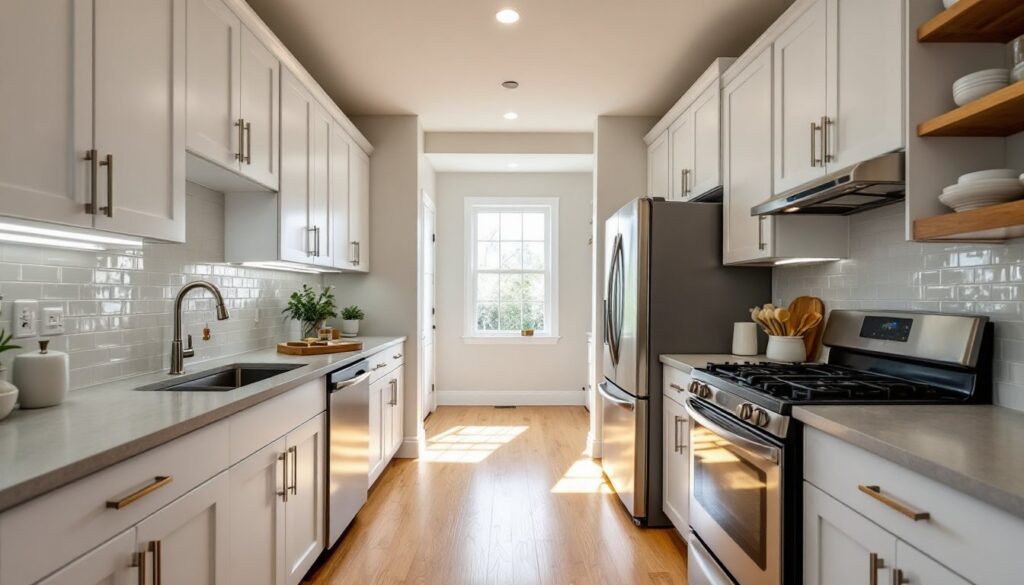
A galley kitchen layout features two parallel runs of cabinets, countertops, and appliances separated by a central walkway. The name comes from ship galleys, narrow, efficient cooking spaces designed to serve crew with minimal wasted movement. In residential settings, galley kitchens typically range from 3 to 5 feet wide in the corridor, though code and accessibility standards may dictate a minimum clearance of 42 inches between opposing base cabinets to meet wheelchair access requirements under the Americans with Disabilities Act (ADA).
Most galley kitchen design falls into two categories: single-galley (one wall of cabinets with appliances on the opposite wall or an open side) and double-galley (cabinets and appliances on both walls). The double configuration is the classic galley setup and what most people picture when they hear the term. Both types prioritize a linear workflow, placing the sink, stove, and refrigerator, the key points of the work triangle, in a straight or near-straight line along one or both walls.
You’ll find galley kitchens in older apartments, condos, and narrow urban homes where square footage is at a premium. They’re also common in historic or bungalow-style houses built before the mid-20th century, when kitchens were utility spaces rather than social hubs. Even though the shift toward open-concept living, the galley layout remains a practical choice for small footprints and has seen a resurgence among designers who value efficiency over sheer size.
Advantages of Galley Kitchen Layouts
Efficiency is the galley kitchen’s standout feature. With everything within arm’s reach, cooks spend less time walking between prep zones. The compact work triangle, sink, stove, and refrigerator positioned along parallel walls, minimizes steps and keeps workflow tight. Professional chefs favor galley-style layouts in commercial kitchens for exactly this reason.
Cost savings follow naturally. Galley kitchen layout ideas often require fewer linear feet of cabinetry, less countertop material, and shorter runs of plumbing and electrical. A typical galley remodel might need 10 to 14 feet of base cabinets versus 18 to 22 feet in a U-shaped or L-shaped kitchen. That’s a meaningful difference when quoting out custom cabinets or stone counters at $60 to $150 per linear foot for materials alone.
Space utilization is another win. Galley designs fit naturally into narrow, rectangular rooms and hallways. They leave adjacent floor area open for dining or living space, critical in apartments or small homes where every square foot counts. Unlike islands or peninsulas, which demand clearance on multiple sides, galley layouts keep traffic paths simple and predictable.
Finally, galley kitchens suit solo or tandem cooking. Two people can work side by side without crossing paths constantly, provided the corridor is wide enough. One handles prep on one wall, the other manages the stove or sink on the opposite side. It’s a practical setup for couples or roommates who share cooking duties.
Common Challenges and How to Overcome Them
Narrow aisles top the list of galley kitchen complaints. If the corridor between cabinets dips below 42 inches, two people struggle to pass comfortably, and bending to access lower cabinets or appliances becomes awkward. This can also create accessibility issues for wheelchair users or anyone with mobility aids. Code varies by jurisdiction, but the International Residential Code (IRC) generally calls for a minimum 40-inch clearance in kitchens, with ADA guidelines recommending 60 inches for full wheelchair turning radius. If you’re remodeling, verify local requirements before finalizing cabinet depth.
Limited counter space is another friction point. Galley kitchens rarely accommodate long stretches of uninterrupted work surface. Appliances, especially the range and sink, break up counter runs, leaving narrow zones for prep. To counter this, consider installing pull-out cutting boards or flip-up countertop extensions at the ends of runs. Some homeowners swap a section of base cabinets for a rolling butcher-block cart that doubles as mobile prep space and storage.
Poor lighting compounds the cramped feeling. Galley kitchens, especially those without windows at either end, can feel dim and tunnel-like. Overhead lighting alone won’t cut it. Add under-cabinet LED strips to brighten work surfaces, and install recessed ceiling fixtures every 3 to 4 feet along the length of the galley. If possible, position a pendant or flush-mount fixture near the center to balance ambient and task lighting.
Dead-end traffic flow frustrates households where the kitchen doubles as a hallway. If your galley opens at both ends, foot traffic cuts straight through the workspace. Installing a pocket door at one end can reclaim control over the space, or rethinking the floor plan to create an alternate circulation path may be necessary, though that often involves more extensive structural work and permitting.
Essential Design Tips for Galley Kitchens
Smart design choices transform a galley from functional to comfortable.
Color and Finish Strategy
Light colors expand visual space. White, off-white, or pale gray cabinetry paired with light countertops keeps the room from feeling closed in. Glossy or semi-gloss cabinet finishes reflect light better than flat paints or stains. If you prefer darker tones, reserve them for lower cabinets and keep uppers light, or vice versa for contrast without heaviness.
Flooring Direction
Run flooring perpendicular to the length of the galley, across the narrow width, to visually widen the space. Lengthwise planks or tiles can emphasize the tunnel effect. This principle applies to wood, luxury vinyl plank (LVP), or ceramic tile. If you’re laying 12-inch by 24-inch porcelain tile, orient the long edge across the corridor.
Appliance Selection
Choose slimmer appliances where possible. A 24-inch-wide refrigerator or a 20-inch dishwasher can free up precious inches. Counter-depth refrigerators eliminate the bulky overhang of standard models, creating a flush look and more aisle room. Slide-in ranges sit flush with countertops, avoiding the gap and lip of freestanding models, cleaner visually and easier to wipe down.
Cabinet Hardware
Recessed or slim pulls prevent snags in tight quarters. Oversized handles jutting into the aisle catch hips, bags, and belt loops. Consider cup pulls or finger pulls routed into cabinet edges for a streamlined profile.
Optimize Your Work Triangle
The classic work triangle, sink, stove, refrigerator, should total 12 to 22 feet in perimeter for efficient movement. In a galley, this naturally collapses into a linear or near-linear path. Place the sink in the center of one wall if possible, with the refrigerator and range flanking it on either the same wall or the opposite one. Avoid forcing someone to cross the galley repeatedly for basic tasks.
If you’re doing a full gut and relocating plumbing, consult the International Plumbing Code (IPC) for venting and drain slope requirements. Moving a sink or dishwasher more than a few feet often means rerouting drain lines and vents, work that typically requires a licensed plumber and a permit. Budget for professional help if structural or code compliance questions arise.
Storage Solutions That Maximize Vertical Space
Galley kitchens demand creative storage. Horizontal real estate is limited, so go vertical.
Full-Height Cabinets
Extend upper cabinets to the ceiling instead of stopping at the standard 30 or 36 inches above the counter. The top shelves may require a step stool, but they’re ideal for seasonal items, serving platters, or small appliances used occasionally. This approach also eliminates dust-collecting soffits.
Pull-Out Organizers
Base cabinets benefit from pull-out shelves, spice racks, and trash/recycling bins. These maximize depth and eliminate the black hole at the back of a standard shelf. Many kitchen design experts recommend dedicating at least one base cabinet to a pull-out pantry unit, a narrow vertical rack that slides out to reveal multiple tiers of storage.
Wall-Mounted Solutions
Install magnetic knife strips, pot racks, or pegboard panels on any open wall space at the ends of the galley. This keeps frequently used tools accessible without cluttering counters. Be sure to anchor into wall studs (typically 16 inches on center) or use appropriate drywall anchors rated for the load. A cast-iron skillet weighs several pounds: a poorly mounted rack will pull free.
Open Shelving
Swapping a few upper cabinets for open shelves can lighten the visual weight of a galley kitchen. Display everyday dishes or glassware for easy access. Keep in mind that open shelves collect dust and grease, plan to wipe them down regularly. This works best on one wall: doing both sides may feel too exposed and cluttered.
Best Layouts: Single vs. Double Galley Configuration
Double-galley setups place cabinets, countertops, and appliances on both walls. This is the archetypal galley kitchen layout and offers the most storage and counter space within a narrow footprint. The aisle width is the critical variable: too narrow and it feels claustrophobic: too wide and you sacrifice efficiency. Aim for 42 to 48 inches of clearance. Many kitchen design guides recommend the wider end of that range if two people cook regularly.
In a double galley, consider placing the sink and dishwasher on one wall and the range and refrigerator on the other. This splits wet and dry zones, reducing the chance of water splashing near electrical outlets for small appliances. Plumbing for the sink should align with existing drain and vent stacks when possible to avoid costly rerouting.
Single-galley (or “one-wall”) layouts line all appliances and cabinetry along a single wall, with the opposite side either open or occupied by a dining table, pantry, or minimal storage. This configuration works well in studio apartments or very small homes where the kitchen shares space with the living area. The main drawback is reduced storage and counter space, everything competes for linear footage on one wall.
If you opt for a single galley, prioritize vertical storage even more aggressively. Tall pantry cabinets, 84 or 96 inches high, can offset the lack of a second wall. Some homeowners install a shallow 12-inch-deep shelving unit or a row of hooks on the opposite wall to hold mugs, utensils, or spices without creating a true second run of cabinetry.
Which layout suits your space? Measure the room carefully, actual dimensions, not estimates. A double galley demands a room at least 7 to 8 feet wide to accommodate 24-inch-deep base cabinets on each side plus a 42-inch aisle. Narrower rooms may force a single-galley plan or require custom shallow cabinets (18 to 21 inches deep) on one or both sides. Keep in mind that deviating from standard cabinet dimensions often increases cost, since custom or semi-custom fabrication replaces stock units.
Before finalizing cabinet installation, mock up the layout with painter’s tape on the floor. Walk through the space, open imaginary appliance doors, and simulate typical cooking tasks. This low-tech step catches clearance issues and awkward placements before you commit to materials and labor.